This Used To Be a Thing: Chapel Cars
The original Holy Rollers.
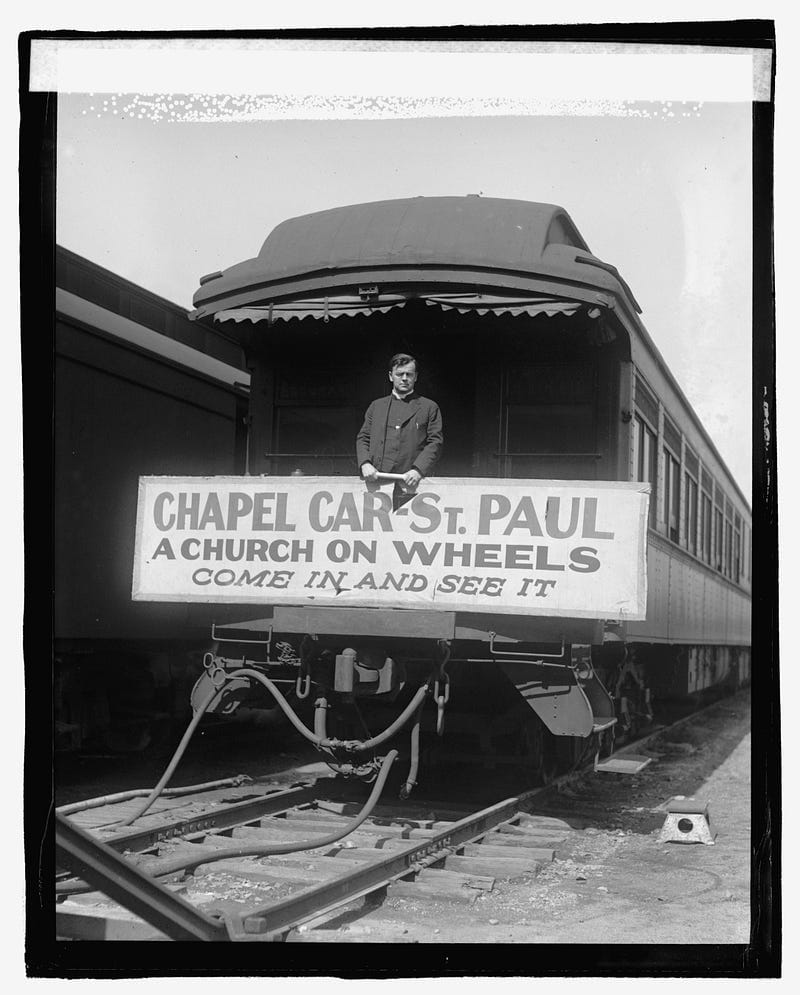
The rise of the American railroads in the 1800’s led to the rise of settlements along the newly established routes as the colonial population continued to expand westward.
In general, most of these settlements consisted of a grocer, a town hall, perhaps a few other businesses, and multiple saloons. (What else was there to do?)
But very few churches. And religious leaders were concerned. How could they effectively administer to their far-flung flocks?
Well, since the people couldn’t get to the church, the railroads would bring the church to the people.
But that inspiration didn’t strike until an Episcopalian Bishop named David Walker from North Dakota visited Russia in the 1880’s.
The Russian Orthodox Church originated the concept of mobile houses of worship during construction of the Trans-Siberian railroad, to ensure the workers had access to places of worship while they built the lines in remote areas.
Upon his return, Walker began raising the needed funds to build America’s first chapel car. The Cathedral Car of North Dakota, built by the Pullman company, began service in 1890.
The idea was simple. The Bishop would travel to a certain area where a sidetrack was available, stay for a certain period to provide services to the local population, then eventually hook up with another train and repeat the process.
The chapel cars served many purposes. They were outfitted with modest accommodations, including a kitchen, for the paster and sometimes an assistant, which eliminated the need for a settlement to have a hotel.
The cars were large enough to store all needed supplies, including any literature they would hand out to parishioners.
Bishop Walker’s travels were a smashing success, with services often filling to capacity.
Other groups soon followed suit. The Baptists were up and running with Evangel, dedicated in Cincinnati in 1891.
Then the Catholics literally got on board. A priest toured one on the Baptist cars at the St. Louis World’s Fair in 1904, and decided they needed to get on the rails, as well. They renovated a used Pullman car, and the St. Anthony was roaming the countryside by 1906.
Though the cars were successful, the work was grueling. Not only did the missionaries have to run their churches practically single-handedly, they also performed all maintenance on the cars, cooked their own meals, and performed all janitorial services.
Although the cars were supported by their religious organizations, they would not have been economically viable without the granting of free passage by the railroad companies. The cars could be attached to existing trains already running set schedules, and the missionaries and staff could also ride free of charge.
At their peak, thirteen chapel cars of various denominations crisscrossed America by the early 20th century. But, as usual, a combination of geopolitical turbulence and technological advances would spell their eventual end.
In the early 1900’s, U.S. regulations mandated steel construction for safety. Since most cars were made of wood, they would need to be rebuilt. Also around this time, American railroads ended the practice of letting chapel cars ride the rails at no cost.
Then came America’s entry into World War I. The government took over operation of the railroads, and mandated the rails must be used for troop and material transportation only. Chapel cars were considered “private,” and service was essentially halted. Once the war ended and the industry was returned to private control, service was very slow to resume due to financial pressures on the railroad companies.
Plus, the chapel cars would ultimately prove too successful for their own good.
As parishioners flocked to these mobile services, many would be moved to start their own congregations. As more and more churches sprung up along the lines, the cars had fewer places to stop.
And what their own success would start, the automobile would eventually finish. Not only were there more churches, cars made them easier to get to. One by one, the chapel cars would be retired as they reached the end of their service lives. The last car would be retired in the early-1960’s.
We are finally on social media.. Come say hi…
Subscribe and follow our official social handles on Instagram | X | Facebook.
Feel free to mention / tag us on these social platforms whenever you want to promote or collaborate on your content. We love watching you grow with this community.
This story published on “Pen With Paper” — a fresh space where writers bring their thoughts, stories, and ideas to life. Want to share your voice? Join our community, and together, “We Elevate Your Stories”