This Used To Be A Thing: The Glass Armonica
Can’t History Just Lighten Up a Little Bit?
I understand we live in very troubling times, and perhaps now, more than ever, we need to take seriously the lessons of history. Those who haven’t learned from it (or just plain ignoring it) seem on the verge of repeating its biggest mistakes.
But pity the poor historian, having to constantly remind us of all the horrible things we’ve done, and highlighting over and over again the worst episodes of our shared past. No wonder history tends to be one of most people’s least favorite subjects, right up there with math and using your smart phone after the latest update.
History can use a break, you know? Show its lighter side once in a while? Maybe even give us a laugh now and then?
Welcome to “This Used To Be A Thing.”
These posts will focus on now obscure and/or completely extinct facets of what once was everyday life, be it the tools we used, jobs we did, technology we relied on, or other random historical weirdness. Anything which might make you think, “Wow, this used to be a thing?!”
And the weirder, the better. Anyone remember “Ripley’s Believe It or Not?” Sorta like that, but with much more snark. I’ll try to keep the “ick” factor to a minimum, but no guarantees.
Though I obviously do my best to fact-check, these pieces should by no means be misconstrued as educational. If you do accidentally learn something, that’s on you. This should by no means be a part of any sort of study prep for your next history exam.
And with that caveat, on to our first edition of This Used To Be A Thing — the Glass Armonica.
<><><><><>
Oh, that Benny Franklin.
We all know the key-on-the-kite thing, the Founding Father thing, maybe even the bifocals thing (dude invented a lot of stuff). But apparently at some party he attended, someone was making music by rubbing the rims of wine glasses filled with different levels of liquid (you can hear the sound right now, right?) and he thought, “This is wonderful! But what a pain — you gotta find all the glasses, fill them, set ’em up just right. And if they don’t have enough, it really limits your catalogue. I gotta make this more portable. I’m gonna invent a musical instrument that does this.”
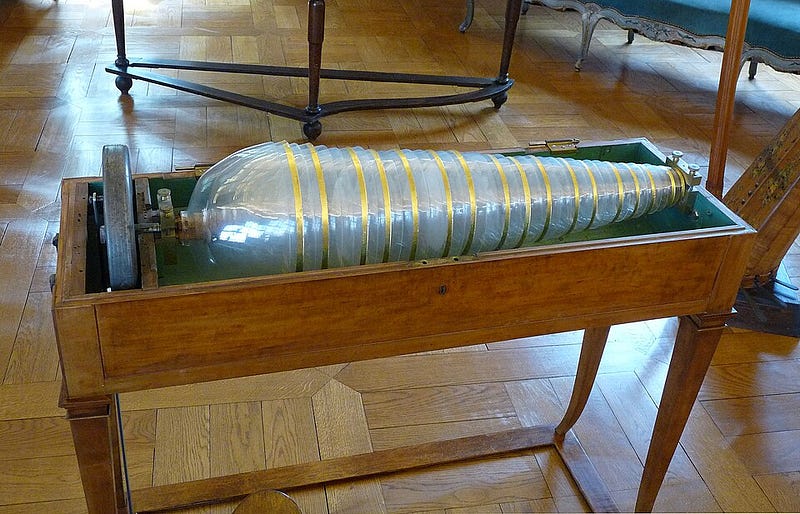
Behold, the Glass Armonica.
The glass armonica is basically a bunch of nested glass bowls with a rod going through the center of them. Picture a skewer at a Brazilian steakhouse.
This “skewer” is placed sideways in a cabinet, with a foot petal connected to the rod to spin the bowls. The armonica player would dip their fingers in water, then place them on the edges of the spinning bowls to create music, the notes of course determined by the size of each bowl.
This thing was actually kind of a hit, especially in Europe. Mozart (!) even composed pieces for it.
Until it was considered cursed.
Enter (as what usually happens in tales like this) the Nefarious Character — a German doctor named Franz Mesmer, practicing in Paris in the late 18th century.
Dr. Mesmer was, to put it kindly, unconventional. Among other things, he practiced an early form of hypnotism, which included playing the armonica. He would use its eerie sounds to lull susceptible people into a trance-like state.
Without getting too specific, by the end of each session, Dr. Mesmer’s “patients” (usually wealthy women, attended to by handsome young men) would be … how to say this delicately … overcome with emotion, convulsing and even feinting. I’m sure the 18th century version of Yelp contained many VERY enthusiastic five-star reviews.
As his popularity grew, these “mesmerism salons” were held in ever larger venues. The bigger the space, the more theatrical the productions, especially the above-mentioned, um, Grand Finales.
These salons got so popular (and notorious) that Benny himself, who was by then living in Paris as an ambassador, was invited by a French royal medical commission (who considered all of this a sham) to attend one of these gatherings to see for himself how his invention was being used.
Benny was indeed shocked, although one really couldn’t blame him if he thought, “Why didn’t I think of this?”
Needless to say, Mesmer and mesmerism were eventually denounced as hoaxes and frauds. The armonica’s popularity declined, to the point where some even believed it possessed demonic powers, and that no one susceptible to nervous disorders or depression should even listen to it.
There were also anecdotal reports of those expert at playing the device suffering from various maladies, especially in their fingers. Although nothing was ever proven, some speculate this may have occurred from the lead in the paint which identified the notes on each bowl.
The instrument was doomed to obscurity until, sometime in the mid-20th century, a glassblower named Gerard Finkenbinder encountered one on a visit to Paris and vowed to make one of his own. Indeed, since the mid-1980’s, his company, G. Finkenbinder, Inc., continues to produce them in Waltham, Massachusetts. (And, as of this writing, there’s a six-month wait list.)
But, even with this revival, it seems the glass armonica cannot escape its tortured and seemingly cursed past.
You see, Dr. Finkenbinder was also a pilot. In May 1999, he took off on an impromptu flight, supposedly from his studio in Massachusetts to his home in New Hampshire. The plane, with Finkenbinder aboard, at first flew in the wrong direction, then lost radar contact, then completely disappeared. No traces of either have ever been found.
Pretty mesmerizing tale, eh?
We are finally on social media.. Come say hi…
Subscribe and follow our official social handles on Instagram | X | Facebook.
Feel free to mention / tag us on these social platforms whenever you want to promote or collaborate on your content. We love watching you grow with this community.
This story published on “Pen With Paper” — a fresh space where writers bring their thoughts, stories, and ideas to life. Want to share your voice? Join our community, and together, “We Elevate Your Stories”