This Used To Be a Thing: the Telharmonium
The world’s first “streaming” music service.
Technology’s an amazing thing, isn’t it? You can pick up your phone, hit any number of buttons, and immediately hear music playing anytime of the day or night.
How wonderful it is to live in the 21st Century!
Oh, sorry, 1895 just called. It said “hold my beer.”
The concept of listening to music through a telephone was first conceived in the late 19th Century by inventor Thomas Cahill. He patented the world’s first music synthesizer, a device he called the Telharmonium (combining telegraphic and harmony).
Using Cahill’s synthesizer technology, entire symphonies and operas could be produced by just two people playing elaborate keyboards (think pianos on steroids).
These compositions would be pushed along telephone lines. People who subscribed to the service could just pick up their phone, connect, and immediately hear whatever was being performed.
Listening to music on-demand from the comforts of your own home was nothing short of revolutionary. Commercial radio broadcasts were still far off on the horizon.
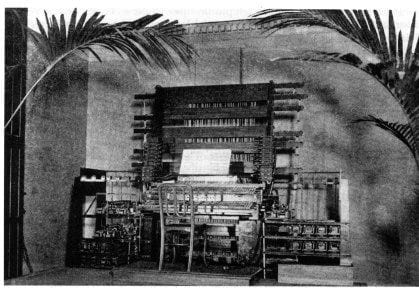
Did I mention the Telharmonium weighed more than 200 tons and took up an entire basement of a New York City building?
Music amplification over loudspeakers was also still a ways off. Indeed, the only speaker that existed at that point was inside a telephone earpiece.
Without the aid of amplification, the Telharmonium had to generate enough of its own power to push the sound waves across the phone lines and into the earpieces. The machine looked more like a massive generator than an instrument.
Definitely would not fit in your pocket.
Just above the basement in the Telharmonium building was Telharmonic Hall, where the keyboardists performed in front of a seated audience.
Since the infrastructure to provide the service to private homes did not yet exist, it was initially sold to gathering places like hotel lobbies and restaurants. The pitch was obvious — it would be far cheaper to subscribe than to hire musicians to entertain your customers, right?
Seemed like a no-brainer. So why is the Telharmonium no longer a thing?
The enormous amount of power needed to carry the signal was a constant problem. When it wavered, volume was often quite faint and/or the quality distorted through the earpieces. When it was sufficient, it led to crosstalk — music would often bleed into other nearby phone lines, interrupting conversations. AT&T received enough complaints to eventually pull out of supporting the project.
Cahill himself had already sunk a tremendous amount of money into his creation, eventually developing three generations. And mountains more money would be needed to create the infrastructure (it would basically need its own power plant) for enough individual subscriptions to potentially even cover his costs, let alone see any kind of profit.
He eventually declared bankruptcy in 1916, and by 1920 the behemoth machine was removed from its NYC basement and ultimately sold for scrap to help defray his debts.
Although no recordings of the Telharmonium are known to exist, its legacy lives on.
American watchmaker Laurens Hammond developed an electronic organ in the mid-1930’s, using the same technology Cahill invented for his machine. Only the Hammond organ was the size of a small piano (not on steroids) that could fit on any stage or in anyone’s home.
The difference? Again, amplification. Electronic amplification enabled sound waves to travel much farther with dramatically smaller components and far, far less electricity.
No additional power plant needed.
We are finally on social media.. Come say hi…
Subscribe and follow our official social handles on Instagram | X | Facebook.
Feel free to mention / tag us on these social platforms whenever you want to promote or collaborate on your content. We love watching you grow with this community.
This story published on “Pen With Paper” — a fresh space where writers bring their thoughts, stories, and ideas to life. Want to share your voice? Join our community, and together, “We Elevate Your Stories”