This Used To Be a Thing: Variable Time
When an hour wasn’t really an hour.
Time’s relentless, we all know that. The seconds, minutes, and hours tick by, the one constant in a world of continual change. As it was, so it always shall be, right?
Not exactly.
Sometimes an hour was more than hour. Sometimes it was less.
Let me explain.
The earliest human civilizations were agrarian — they lived strictly off the land. They hunted and eventually learned how to cultivate and grow crops. Sumerian and Babylonian cultures were the first to develop calendars to mark time to guide them for planting and harvesting.
As religions took hold, and agriculture became more commonplace, significant events, like church ceremonies and harvest, were dictated by the position of the sun in the sky, since these early societies had little or no access to artificial light.
But a more accurate way to schedule these events was needed. Most accounts point to the Ancient Egyptians as the ones who derived the first attempts at daily timekeeping. They divided daylight into twelve equal intervals, the first beginning at sunrise, the last ending at sunset.
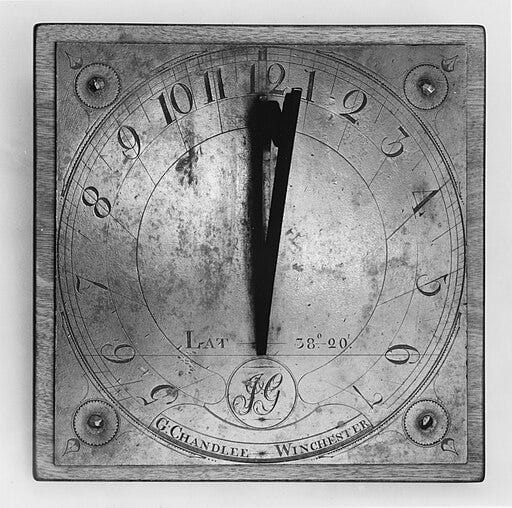
They eventually developed sundials to indicate these intervals, or “hours” of each day. At first these weren’t much more than just sticks stuck into the ground to measure shadows. The time of day was determined by their length and direction.
As they became more sophisticated, sundials eventually evolved into flat discs with an object (usually a small metal plate, or “gnomon”) placed somewhere in the middle, sticking out to cast a shadow as the sun moved through the day.
The dial was divided into twelve sections, similar to today’s clock faces. The position of the shadow in relation to those sections indicated the current time.
One problem with this, though — the seasons. As we now know, the length of day and nighttimes shift as the seasons change. Longer daylight in summer, shorter in winter.
Regardless, the number of hours of light remained at twelve. Which obviously means that each hour of daylight during winter was much shorter than during summer. This concept is known as variable, or temporal time.
To account for this, the lines delineating the sections were arced, or curved, rather than straight. Since the tip of the shadow indicating, say, the sixth hour of day would vary as the seasons passed, the line indicating the sixth (and all hours) was curved to accommodate.
This was all well and good for about, oh, 2500 years or so.
Of course, as civilization evolved and humans continued traveling, connecting, and most importantly trading, a more reliable, consistent method of marking time was needed. In addition, sundials were pretty useless for astronomers who were starting to chart the skies as night.
The first mechanical clocks appeared in the late 13th century. This advance in timekeeping made it possible to divide time into even smaller increments.
As precise as these new inventions were, they couldn’t be adjusted to account for variable daylight. An hour was an hour was an hour, regardless of the time of year.
As timekeeping technology advanced and measuring time became more and more accurate, the use of variable time eventually fell out of favor. The fundamental increments of seconds, minutes, and hours had pretty much become universal practice by the 16th and 17th centuries.
Regardless of how it’s divided, however, no one has yet figured out a way to make it go any slower.
We are finally on social media.. Come say hi…
Subscribe and follow our official social handles on Instagram | X | Facebook.
Feel free to mention / tag us on these social platforms whenever you want to promote or collaborate on your content. We love watching you grow with this community.
This story published on “Pen With Paper” — a fresh space where writers bring their thoughts, stories, and ideas to life. Want to share your voice? Join our community, and together, “We Elevate Your Stories”